By Mail On Sunday Reporter
As the Queen prepares to celebrate her Diamond Jubilee, one of her closest relatives and oldest friends has been allowed to give an unprecedented insight into the family life of the Royals. There have been hundreds of other books claiming to offer a glimpse behind Palace doors, but this is the first written by someone who is closely related to the Royal Family and has shared their lives – not only throughout the Queen's reign but also through that of her father, King George VI.
The Final Curtsey, by Her Majesty's cousin and childhood playmate the Honourable Margaret Rhodes, is being serialised exclusively by The Mail on Sunday, starting today.
It tells in enchanting detail the story of Mrs Rhodes's relationship with the Royal Family over eight decades. The book, illustrated with delightfully informal and never-before-seen pictures, has been written with the full knowledge of the Queen, who has read and approved parts of it.

The Queen and I: The Honourable Lady Margaret Rhodes sits resting with the Queen during a trek through deer-stalking area at Balmoral
One of the most remarkable chapters is a vivid and profoundly moving description of the death of the Queen Mother, who was Mrs Rhodes's aunt, on Easter Saturday, 2002.
The author – who worked in the offices of MI6 during the war and is now a sprightly 86 – tells how, when she went to record her aunt's death at the registrar's office in Windsor, she was asked: 'Right, what was the husband's occupation?'
'After a second's hesitation, I answered, "King." She adds: 'I think Queen Elizabeth (the Queen Mother) might have found that almost amusing.' Mrs Rhodes, who was a Lady-in-Waiting to the Queen Mother, paints a colourful and hugely endearing portrait of a much-loved Royal.
'She recalls how, over tea one day, the conversation turned to Tony Blair's Cool Britannia, 'prompting Queen Elizabeth to remark wistfully, "Poor Britannia. She would have hated being Cool." '
Elsewhere in the book she reveals how the Queen Mother was a fan of the TV shows Two Fat Ladies and Dad's Army. Perhaps more surprisingly, she was also a fan of the mystical poet Edith Sitwell and the Poet Laureate Ted Hughes, who was a regular and favoured guest.
Life at Birkhall, the Queen Mother's home on the edge of the Balmoral estate, is described – along with sometimes uproarious dinners. Mrs Rhodes recalls: 'At the end of the meal, Queen Elizabeth would start a series of toasts. As well as "Hooray for..." with glasses held high, there was even more of "Down with..." with glasses almost disappearing beneath the table.'
Mrs Rhodes lives in the Royal enclave in Windsor Great Park in a house given to her by the Queen in 1980. She tells how it was offered out of the blue one day when she and the Queen – whose 60 years on the throne next year will be marked with a series of national celebrations – were out riding at Balmoral. 'She suddenly turned in the saddle and said, "Could you bear to live in suburbia?" '
The Queen and I: by The Honourable Margaret Rhodes
Born in 1925, the youngest daughter of the 16th Lord Elphinstone and his wife Mary (nee Bowes-Lyon), the Honourable Margaret Rhodes has led an extraordinary life. She was the childhood playmate of her cousin, the Queen; a wartime MI6 operative; and Lady-in-Waiting to her aunt, the Queen Mother. Now, at the age of 86, she has written an enchanting autobiography that paints an unprecedentedly intimate portrait of the private world of the Royal Family...
Saturday, March 30, 2002, will be etched in my memory for ever – although it started like any other day at the Garden House, my home in the Royal enclave in Windsor Great Park. The house had been granted to me by my first cousin, the Queen, 22 years earlier. I was out riding with her on the Balmoral estate in Scotland and she suddenly turned in the saddle and said: ‘Could you bear to live in suburbia?’
It transpired that she was offering my late husband Denys and me the Garden House, a short drive from Windsor Castle and almost round the corner from Royal Lodge, the weekend retreat of Queen Elizabeth, the Queen Mother, who was my mother’s youngest sister and my aunt. Queen Elizabeth had been part of my life for as long as I could remember and, as the years passed, she seemed immortal.
She had, however, been unwell since Christmas 2001 and I suppose I had been steeling myself for the worst. I had just returned from a cruise with some friends down the Chilean coast and during that time Princess Margaret had died following a complete breakdown in her health.

The entertainer: The Queen Mother, sporting tartan and a sprig of heather in a jaunty hat, shares a joke with Margaret at the log cabin at Birkhall she named the Old Bull and Bush
She had her third stroke on February 8 and developed cardiac problems. A few days before this, she had told an old friend that she felt so ill that she longed to join her father, King George VI.
My eldest daughter Annabel had telephoned me on board the ship to break that sad news. Queen Elizabeth, although very frail, had insisted on coming down from Sandringham, where she had been staying since Christmas, for her younger daughter’s funeral in St George’s Chapel, Windsor.
I felt so sad about Margaret, but perhaps more for Queen Elizabeth than for anyone else. It is unnatural for a mother to suffer the death of a child, of whatever age, and it compounds the grief.
Margaret, the Queen and I had grown up together and, when young, Margaret had such great promise, beauty, intelligence and huge charm. It seemed a life unfulfilled in so many ways. In childhood, and when she was growing up, she was very indulged, especially by her father.
 If she did misbehave, she invariably defused the situation by making everyone laugh, so that the misdemeanour was forgotten, if not forgiven. It was hard to resist her, but she did have the most awful bad luck with men.
After Margaret’s funeral, Queen Elizabeth returned to Royal Lodge, and did not leave it again. I arrived home at the Garden House on March 3, and found that my aunt was still entertaining visitors.
On March 5 she hosted a lawn meet and lunch for the Eton Beagles, and then held her usual house party for the Sandown Park Grand Military race meeting. But she weakened further in the week before Easter, which that year would fall on March 31.
I had been a Woman of the Bedchamber – a mix of Lady-in-Waiting and companion – to my aunt since 1991 and in her final weeks I went to Royal Lodge every day, usually around 11 or 12, and had lunch with her, the meal being set on a card table in the drawing room.
I tried to amuse her with snippets of news that might interest her. It was difficult to get her to eat much.
About all she could usually manage was a cup of soup, although her chef, her Page and I spent a lot of time trying to think of dishes that might tempt her. But it was wonderful to see her every day, and I would take her little bunches of early daffodils and primroses; any flower that was really sweet-smelling.
I loved her so much, and I like to think that she regarded me as her third daughter, once paying me the compliment of introducing me as such to a visiting Scandinavian monarch. March 30 was sunny and bright and the usual chores, like exercising the dog, had to be undertaken. Then at about 11 o’clock the telephone rang.
It was Sir Alastair Aird, my aunt’s Private Secretary, warning me that the end seemed close.
She had been receiving regular visits from our local doctor, Jonathan Holliday, the Apothecary to the Household at Windsor, and on the morning of her death he was joined by Doctor Richard Thompson, the Physician to the Queen. They concluded that she would not last the day.
As I arrived at Royal Lodge, I saw that the Queen’s car was there. I went straight to my aunt’s bedroom and found her sitting in her armchair. The Queen was beside her, wearing riding clothes.
She had been alerted while riding in the Park – her groom always carried a radio link to the castle. The nurse from the local surgery and my aunt’s Dresser – Royal Household-speak for Ladies’ Maid – were also there.
 A world away from state banquets: The Queen and Margaret enjoy a relaxed lunch at Glen Beg, Her Majesty's log cabin on the Balmoral estate - with the Queen's gin and Dubonnet perched on the side
My aunt’s eyes were shut and thereafter she did not open them or speak another word.
The doctors came and went, but the nurse, the Dresser and I stayed throughout. John Ovenden, the Parish Priest of the Chapel of St George’s, Windsor, arrived and went straight into Queen Elizabeth’s bedroom. He knelt by my aunt’s chair, holding her hand and praying quietly. He also recited a Highland lament that begins: ‘I am going now into the sleep ...’
He later told me that he was sure she knew what was happening because she squeezed his hand. After a while I was persuaded to take a break and went for a walk in the garden. When I came back, she had been put to bed.
She looked so peaceful. At this point the Queen returned, accompanied by Princess Margaret’s children, David Linley and Sarah Chatto. John Ovenden also came back, and we all stood round the bed when he said the prayer: ‘Now lettest thou thy servant depart in peace.’
We all had tears in our eyes and to this day I cannot hear that prayer being said without wanting to cry. Queen Elizabeth died at 3.15 in the afternoon on March 30, 2002. She just slipped away and her death certificate said that the cause of death was ‘extreme old age’.She was 101 – such a very great age.
She had arrived in the world in the time of horse-drawn carriages and was leaving it having seen men walking on the Moon. I returned home soon after, thinking that it was strangely significant that she had died on Easter Saturday, the day before the Resurrection.
 Solitary moment: Prince Philip breaks into his sandwich box for a snack in the shade of a stone house built by Queen Victoria for Prince Albert at Balmoral
It had been a long and emotionally exhausting day, and I was so touched when David Linley telephoned to say that the Queen would like me to spend the night at the castle. That evening passed in rather a blur.
We had dinner and talked about more or less normal things. We went to bed quite early and next morning attended communion in the castle chapel. Later I went to Matins in the park chapel, and then drove over to Royal Lodge,to make sure all was well with the staff.
The Dresser asked me if I would like to see my aunt. She looked lovely and almost younger, death having wiped the lines away. I knelt by her bed and said a prayer for her. Then I stood up and gave her my final curtsey.
 Later, I was deputed to register my aunt’s death at the Windsor registrar’s office. I was shown into the room of a rather fierce-looking lady and we went through the formalities while she ticked the relevant boxes.
At a certain point, she fixed me with a beady eye and asked: ‘Right, what was the husband’s occupation?’ It seemed a superfluous question. However, after a second’s hesitation, I answered: ‘King.’ I think Queen Elizabeth might have found that almost amusing.
Some time in 1990, Queen Elizabeth asked me to lunch at Clarence House. Ruth, Lady Fermoy, the exceedingly elegant maternal grandmother of Princess Diana, was also there. In her way she was as much a fashion plate as her granddaughter and was a senior Woman of the Bedchamber.
When the meal was over, Lady Fermoy invited me up to her sitting room. It was all rather mysterious but she finally got round to the point.
To my complete surprise she told me that Queen Elizabeth wanted me as one of her Ladies-in-Waiting, but found it difficult to ask me herself in case I was reluctant. It would have been impossible to say ‘No’ to her face. My answer, however, was an emphatic and immediate ‘Yes’. I had then been a widow for nine years and having a job gave me a focus which had been lacking since Denys’s death.
I joined a household legendary for its hospitality, conviviality and wit, but underscored by an inexorable sense of duty. It was the unstuffiest of courts and the animating spirit of all this was, of course, Queen Elizabeth. It was not in her nature to behave as though her privileged position was a crushing burden.
By temperament an enjoyer of life, she entered into everything she did with gusto and expected those close to her to do the same.
I can only say that I did my best. She turned even the most tedious occasion into a party, and from my own experience I fully agree with the anonymous leader writer at The Times, who once said of her: ‘She lays a foundation stone as though she has discovered a new and delightful way of spending an afternoon.’
She never, however, forgot what she owed to people whose lives were less comfortable, pleasant and interesting than her own. She kept her politics from the public gaze, but no one could say that she leaned towards the Left. Despite this, she got on well with many Labour politicians and had a deep concern about social conditions.
But I do remember my daughter Annabel having tea with her and the conversation touching on Tony Blair’s then latest wheeze, ‘Cool Britannia’ ... prompting Queen Elizabeth to remark wistfully: ‘Poor Britannia. She would have hated being Cool.’
When I was recruited, there were two Ladies-in-Waiting with titles, who turned out only for the very grandest of occasions, and eight Women of the Bedchamber.
We ‘Women’ did fortnightly periods ‘in-waiting’ and accompanied the boss on her official engagements.
Our rather elderly entourage was very well briefed on how to behave before we went out to meet the public – as if we didn’t know – and the Private Secretary would warn us about any potential trouble spots, such as tricky stairs and steps.
Fortunately, when I was in-waiting there were no mishaps. We were always supplied with the names of everyone we could possibly meet, and details
of what they were interested in, so that there would be no awkward silences. Our handbags contained the little extra necessities of life to make a Royal visit go like clockwork.
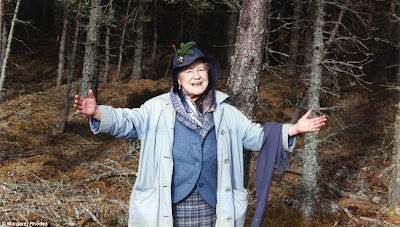 Portrait of joy: A charming photo taken in the Balmoral woods perfectly captures the Queen Mother's abiding love of the countryside
I did not know the contents of Her Majesty’s handbag, but there was astounded merriment at Clarence House when the satirical magazine Private Eye suggested that she never ventured far without an ironed copy of The Sporting Life, a packet of Marks & Spencer chocolate eclairs, a ready mixed gin and Dubonnet in a hip flask, and a large number of £50 notes ‘just in case’.
At Clarence House I had a housemaid to look after me, lay my clothes out and pack and unpack for me. She would turn down my bed in the evening and draw the curtains.
I could have had breakfast in bed every morning, like some of my more elderly colleagues, but I decided I was not quite old enough for that and anyway couldn’t be bothered with the fuss it entailed. This involved a Page leaving the breakfast tray outside the door, retreating out of sight and then a housemaid knocking and carrying it in.
 I do now, however, at the age of 86, allow myself breakfast in bed when I visit Balmoral and Sandringham, my years now meriting this privilege. I knew, of course, all about curtseying well before I joined the Royal Household. Some people say that they are not curtseying to the individual Royal, as such, but acknowledging what they represent – the nation.
Personally, I curtsey to the individual. So curtseying on first seeing Queen Elizabeth in the morning, and on saying goodbye or goodnight, was perfectly natural as far as I was concerned. Official engagements never started before the sun was well and truly up and they were conducted at a leisurely pace.
Queen Elizabeth liked to give full value, and so they often ran late, which didn’t bother her at all, although some members of the Household accompanying her occasionally got twitchy. She had an inherent magic and I have seen even the most die-hard republicans melt when she directed the full beam of her blue-eyed charm at them.
Her engagements had a sense of the theatre and I remember a Royal observer telling me: ‘When she steps out of her car it’s like curtain-up.’ She certainly always gave a flawless performance, although I believe it went much deeper than that because she genuinely liked people of all sorts and conditions.
She had the gift of making people believe that they were the only person in the world she wanted to talk to at that given moment. And she had a wonderful sign-off line.
It went something like this: ‘Well, I’d love to stand here talking all day, but I really must get on,’ as if she had to get home and put the joint in the oven. People were enchanted by this mix of cosiness and glamorous royalty. It was Thelma Furness, the society beauty of the 1930s, and girlfriend of the then Prince of Wales, who once remarked of Queen Elizabeth, who was then Duchess of York: ‘If ever I was reduced to living in a bungalow inBognor, the person I would most like to have living next door to me would be Elizabeth of York.’ Quite.
Princess Diana also had this gift for scattering stardust, although in a much more overt way. But Queen Elizabeth was compassionate, too, although she did not brim over with it before the crowds. She was not one for the binding up of wounds in public.
A no-nonsense woman, she did not admit to illness, unless totally unavoidable, and regarded aspirin as a dangerous drug. Her idea for the curing of a bad cold was a bracing walk in a stiff breeze across rugged terrain. It invariably worked!
But in her youth and her early years of marriage, she often suffered from a debilitating cough and bad chest. When I was not trailing round after her, coping with the overflow of bouquets and keeping conversation going along VIP line-ups, I spent a lot of my time at Clarence House responding to letters. Queen Elizabeth hada huge post, and every letter had to have a response, even if written by some poor person who was mildly deranged.
There were quite a few of those, and also from people passionate about various causes, and from children. We tried to be as helpful and kind as we could but sadly, and very often, there was nothing we could do and the only course of action was to politely tell the writer that we had referred their problem to the appropriate Government department.
Queen Elizabeth also had an Aladdin’s cave of gifts – a big cupboard of china and other bibelots – which could be dipped into, gift-wrapped and sent with a letter.
Normally the recipients were charities, particularly those local to Windsor; Ballater, near Balmoral, and in County Durham, where the Bowes family came from.
What I expected to be my finest hour arrived when one of the real ‘Ladies’ went sick and I was commanded to attend a State Banquet in honour of the King of Malaysia.
Queen Elizabeth lent me a tiara and I felt distinctly grand. The Queen and the State visitors were led in by David Airlie, the Lord Chamberlain, carrying his silver wand and walking backwards.
The banquet is always the highlight of any State visit. It is a time for an exchange of compliments and coded messages about foreign policy, spelt out by host and guest, against a glittering backdrop of gold and silver gilt plate, candelabra, crystal and massed flowers.
 Winning charm: The Queen Mother waves for the cameras during an outing from Royal Lodge, her home at Windsor, with the Queen
The guest list generally numbers 150, and includes all the members of the Royal Family who can be mustered, the Archbishop of Canterbury, the Prime Minister, other members of the Cabinet, representatives of foreign powers who are friendly to the State visitor, industrialists, figures from the arts and sometimes a favourite entertainer or sports person.
In the matter of Royal protocol, Queen Elizabeth had the Archbishop of Canterbury on her right at every single State banquet. The four-course meal always has a musical accompaniment, played by a regimental band – useful for filling conversational gaps.
 President Mugabe of Zimbabwe, to mention just one of the more controversial guests the Queen has had to entertain over the years, was serenaded with a selection which included the best of Half A Sixpence, I Rule The World and something called Jumping Bean.
The Director of Music gets a whisky and soda when it is all over. I wonder if those invited to these occasions realise the amount of work and planning which goes into them. Damask tablecloths, some of them more than a century old, are brought out to cover the side serving tables. Every place setting is measured with a ruler, because no butler worth his salt wants to get to the end of the table with, say, four settings left and nowhere to put them.
Late in the afternoon, the Queen, who expects perfection on these occasions, carries out a personal inspection of the tables. Well, there I was amid all this splendour, sitting next to a man whose firm was supplying a new sewage system to Malaysia. He insisted on passing on every possible detail.
It was not a conversation of memorable enjoyment, but of course the food and wine were excellent and to an extent I was able to anaesthetise myself from waste flows and piping in Kuala Lumpur.
And it was nice to leave the table at the end and not be faced with the washing-up because below stairs a massive clear-up operation was beginning. The 500 crystal glasses; the Minton china; the Sevres or the Meissen ware; the cutlery was all being washed by hand and stored away, ready for the next time.
But, as the Queen says of these occasions and her State visitors: ‘We hope to give them a nice time to remember.’ Queen Elizabeth took every opportunity to have lunch al fresco. The Clarence House garden has two large plane trees under which tables could be placed. She called this green enclave her salon vert.
These lunches were jolly occasions, but there is no truth in the story that towards she end of the meal she would order the tables to be moved close to the wall separating the garden from the Mall, so that she could eavesdrop on the conversations of the passers-by on the other side, in case they said anything complimentary or otherwise about her.
This is a good story, and part of the mythology surrounding her, but moving the tables to such a strategic listening post would have been a physical impossibility because a very large flower bed is in the way. Lunch inside when there were no visitors was held in a corner of the drawing room, and the Lady-in-Waiting would join her.
 Words of wisdom: Prince Charles deep in conversation with his grandmother during a lunch in the sunshine on the Balmoral estate
There were always two gentlemen of the Household in attendance to even up the numbers. Queen Elizabeth liked to do us well. The chef produced excellent food and the wine was of the best. The meal was always followed by cheeses and then fresh fruit and lastly coffee.
She did not at all mind people smoking, saying it reminded her of her husband, her father and her brothers, who all smoked. In the evenings when we dined alone she liked to watch television as we ate and she thoroughly enjoyed cookery programmes, particularly Two Fat Ladies and comedy shows including Dad’s Army.
The key figures in the Household were Sir Martin Gilliat, the Private Secretary, an ebullient figure who sometimes took on the role of master of the revels; the less ebullient, but wonderfully organised Sir Alastair Aird, the Comptroller; and the Treasurer, Sir Ralph Anstruther, who was a whizz with figures, down to the last decimal point, and who doled out my very modest expenses allowance.
 Retirement was not an option, except for the young Equerry, always from the Irish Guards, who was seconded to Royal duties for three years.
There were a number of other people in the Household: the Lord Chamberlain, who when I arrived was the Earl of Dalhousie; a Page of Honour, and two Apothecaries – an antique description for the two highly qualified medical consultants who were on call, one for Clarence House and the other for Royal Lodge.
There were three secretaries, described as Lady Clerks – one of them worked for the Comptroller and one for the Ladies-in-Waiting. The third worked in the office of the Press Secretary, Sir John Griffin. Her duties included fielding media calls, and she had a notice pinned on the wall proclaiming: ‘We don’t leak.’
This was in the days when reportage of the Royal Family was running wild and out of control. The domestic staff was headed by the Housekeeper, and there were also, of course, several footmen, housemaids and chefs.
Prominent among this group were the Page of the Backstairs, William Tallon, and the Page of the Presence, Reginald Wilcock, his close friend. The bouffant-haired Mr Tallon was something of a celebrity with the media, which sensed an outré character among an otherwise faceless band of retainers.
Like all perfect Royal servants, he knew his place, but as his work involved close proximity to one of the most photographed women in the world he found it impossible completely to remain in the shadows.
The media dubbed him Backstairs Billy, but Queen Elizabeth called him William. I believe there was genuine affection between Mr Tallon and his employer, and although the upstairs-downstairs rule applied, William and Queen Elizabeth probably met somewhere in the middle.
He was her longest-serving servant, one of the coterie she regarded as her extended family. Each Christmas she would give him items from a 70-piece dinner service, and he was close to completing the set when she died.
His home, Gate Lodge, at the entrance to Clarence House from the Mall, was like a mini Victoria and Albert Museum. It was exquisitely furnished and decorated with gifts from her private collection, and many from long-standing friends of my aunt, as well as from William’s friends in the ballet and theatre world.
He was devastated by her death, which occurred on the 51st anniversary of the start of his Royal service. With other members of her personal staff, he walked behind her coffin on its journey from the Queen’s Chapel at St James’s to its lying-in-state in Westminster Hall – in attendance to the last.
One of my colleagues, approaching her 80th birthday, began to drop hints that it was about time for her to go, but before she could breathe another word her employer said: ‘Congratulations! You will find that you feel marvellous after you’re 80.’
The subject of retirement was never mentioned again. At the time, Queen Elizabeth was 98. It seemed death was the only exit and I sometimes wondered whether my aunt would see me out. She never mentioned dying, only occasionally obliquely referring to someone having ‘gone upstairs’.
An example of an intensely loyal courtier staying in post until the end was Martin Gilliat, a very brave man who had been a Colditz ¬prisoner.
He had been diagnosed with cancer, but although he was seriously ill, Queen Elizabeth threw a party in 1993 to celebrate his 80th birthday, which ended with the usual nostalgic sing-song round the piano.
 Enjoying the garden: Margaret with the Queen, resplendent in her kilt, pausing for a snap during a quiet stroll around Balmoral
Afterwards, Martin carried on for more than three months, a shadow of his former sparky self but still forcing himself to work from his flat in St James’s Palace.
Finally he went into hospital and died three days later. He was much lovedand I know Queen Elizabeth deeply mourned the indomitable man who had run both her official and private life for nearly 40 years.
Shortly afterwards, Lady Ruth Fermoy died of inoperable cancer and the two deaths left her bereft. Of all the Royal homes, Birkhall, on the edge of the Balmoral estate, was the one I most deeply loved. I had been going there since I was five years old.
Before Queen Elizabeth enlarged it, Birkhall was little more than a small 18th Century dower house. There were few rooms for visitors; the nursery and the sparse accommodation were filled whenever Queen Elizabeth held open house.
There was one large room in the tin-roofed annexe where,as a child, I played with Princess Elizabeth and Princess Margaret. The burn, the Muick, burbled away at the bottom of the steeply sloping garden and behind rose the fir-clad heights of the Coyles of Muick.
In October the birches turned bright yellow and the rowans scarlet and one could hear the stags roaring their autumnal defiance.
At Birkhall, lunch was never indoors, whatever the weather, except on Sunday, which had to be observed with some degree of formality, after attending the Kirk. Queen Elizabeth’s friends and relations all contributed to the cost of building a charming little wooden cabin beside one of her favourite pools in the River Dee.
She called it the Old Bull And Bush after a pub near Hampstead Heath, immortalised in the music-hall song Down At The Old Bull And Bush performed by Florrie Forde in the 1920s, when Queen Elizabeth was a girl. She loved the old songs and knew all the words. In another life she might have been a star of the ‘Halls’.
Dinner at Birkhall could be an uproarious affair. At the end of the meal, Queen Elizabeth would start a series of toasts. As well as ‘Hooray for ...’ with glasses held high, there was even more of ‘Down with ...’ with glasses almost disappearing beneath the table.
The toasts, combined with the simultaneous chiming of six grandfather clocks, and the community singing - Lloyd George Knew My Father was a firm favourite - made for an unforgettable evening. So, being in-waiting was not all protocol and curtseying: it was, in fact, tremendous fun.
source:dailymail


 6:45 AM
 ms.tk
ms.tk
 Formal: Prince Harry looks unusually serious as he stands behind his new sister-in-law Catherine, the Duchess of Cambridge, on the balcony of Buckingham Palace
 Royal Joker: Harry hides his face as Catherine bursts out laughing at the Trooping the Colour to mark the Queen's 85th birthday
 Laughs: The Duke and Duchess of Cambridge share a joke on the balcony of Buckingham Palace during Trooping the Colour
  Salute: The 28-year-old Prince took part in the parade for the first time to mark his grandmother the Queen's official birthday
  Eyes on the skies: (L-R) Duchess of Cambridge, Prince William, Duchess of Wessex, Prince Edward, Louise Windsor, Tim Lawrence, Princess Anne, Queen Elizabeth, Prince Harry, Prince Philip, Prince Andrew, Duchess of Cornwall and Prince Charles
  Formal: Prince Harry looks unusually serious as he stands behind his new sister-in-law Catherine, the Duchess of Cambridge, on the balcony of Buckingham Palace
 Royal Joker: Harry hides his face as Catherine bursts out laughing at the Trooping the Colour to mark the Queen's 85th birthday
 Laughs: The Duke and Duchess of Cambridge share a joke on the balcony of Buckingham Palace during Trooping the Colour
  Salute: The 28-year-old Prince took part in the parade for the first time to mark his grandmother the Queen's official birthday
  Eyes on the skies: (L-R) Duchess of Cambridge, Prince William, Duchess of Wessex, Prince Edward, Louise Windsor, Tim Lawrence, Princess Anne, Queen Elizabeth, Prince Harry, Prince Philip, Prince Andrew, Duchess of Cornwall and Prince Charles


