Powered by Blogger.
Showing posts with label Earthquake. Show all posts

Saturday, June 11, 2011

Back from the dead: Astonishing pictures show how Japan is recovering just three months after tsunami

By EMILY ALLEN

The pleasure boat ''Hamayuri'' washed up on the rooftop of an inn by tsunami and a building have so far been removed in the town of Otsuchi, Iwate Prefecture, on April 6, top, and on June 3, bottom.


Japan's economy shrank 0.9 percent in the first quarter but recovery is expected between July and September

Just three months ago Japan was plunged into chaos after a cataclysmic earthquake sent a merciless tsunami crashing through towns and cities up and down the east coast.

The unforgiving tide of water obliterated tens of thousands of buildings, devouring almost anything in its path. Thousands of people died and hundreds of bodies have never been recovered.

The heart-breaking images of families desperately searching for loved ones amid the rubble of their homes sent shockwaves around the world.

Now, three months on, these images show the Japanese people remain undaunted by the havoc nature has wreaked on their homeland as step by step they rebuild their nation.


A Shinto shrine gate and surroundings in the town of Otsuchi, Iwate Prefecture three days after the March 11 earthquake and tsunami and the same spot on June 3


But despite their progress, stark reminders of the work left to do means the resilience of this Asian country is still being tested.

Headway in the clean-up has been made in the town of Otsuchi in Iwate Prefecture where the pleasure boat ''Hamayuri'', which was remarkably washed up on the rooftop of an inn, has been removed, along with a building shattered by the the wall of water.

Further down is an image of a Shinto shrine gate in the town three days after the March 11 disaster.

The same spot on June 3 which shows thousands of tonnes of rubbish, which had lay smouldering in an almost post-apolcalyptic landscape, has been cleared, roads re-laid and power lines restored.

Civilisation appears to have returned in Natori in Miyagi prefecture too. The first image shows a towering wall of ocean crashing through trees devastating homes and businesses lining the coast, tearing down power lines and drowning anything in its path.
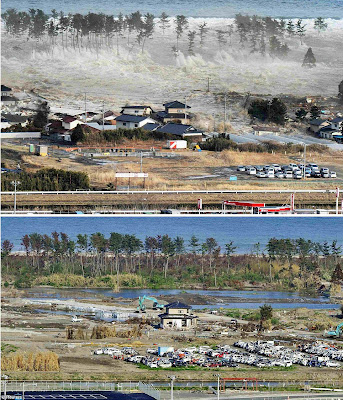

A residential area being hit by the tsunami in Natori, Miyagi prefecture, top, and the same area, with only one house remaining on June 3, bottom


A parking lot of a shopping centre filled with houses and debris in Otsuchi town, Iwate prefecture two days after the earthquake hit and the same area picture on June 3


Astonishingly just one house survived the wave and a lone digger is pictured having cleared away the once thriving community reduced to rubble. Hundreds of cars parked in the foreground remain abandoned and appear to be the only reminder of the devastation.

Similarly, the striking image of a ship atop tonnes of rubble in the Kesennuma in Miyagi prefecture on March 20 was projected around the world and became a symbol of the disaster.

The photograph shows grey smoke filled skies above a path of destruction, but three months on, much of the debris has been cleared, power lines restored and hope is on the horizon.

A car park in a shopping centre, filled with houses and debris in Otsuchi town in Iwate prefecture is also back on its feet and signs of life are returning. Parking spaces are clearly visible where piles of wood, bricks, and vehicles lay strewn just a few weeks ago.


A view of earthquake and tsunami-hit Kesennuma, Miyagi prefecture on March 15, top, and the same area pictured on June 3


The final image shows local people walking through debris on a street in Kesennuma, Miyagi Prefecture to get water 48 hours after the disaster. The same image on June 3 shows the massive tank which lay in the road has gone and a damaged house on the left side of the street has been cleared and restored.

The 9.0 magnitude earthquake caused the worst crisis in Japan since the Second World War and left almost 28,000 people dead or missing.

The clean-up bill is expected to top £184 billion and radiation fears from the stricken Fukushima nuclear plant are still growing after four of the reactors were damaged leading to radiation leaks.

This week, an earless bunny was born near the reactor in north east Japan raising concerns the radiation could have long-term side effects.

Following the blast and initial leaks Japanese officials told people living near the plant to stay indoors and turn of air conditioning and also to not drink tap water.

High levels of radiation are known to cause cancer and other health problems but scientists are not yet clear if the defect in the rabbit is linked to the blast.


Local residents walking through debris on a street in Kesennuma, Miyagi Prefecture, to get water 48 hours after the disaster, top, and the same area on June 3 where a large tank and a damaged house on the left side of the street have been cleared away


Japan's economy slipped into recession following the devastation and new data shows it shrank 0.9 percent in the first quarter of this financial year but experts say a recovery later this year as industry kicks into action.

Industrial output rose one per cent in April from a record decline in March.

Manufacturers are making progress in restoring supply chains and ecnomists are predicting Gross Domestic Project to begin expanding again between July and September.


A view of earthquake and tsunami-hit Kesennuma, Miyagi prefecture on March 20, left, and the same area after the building and debris was removed on June 3


Australian Red Cross - Japan Earthquake and Tsunami devastation


source: dailymail

Friday, March 25, 2011

Estimated 74 dead and over a hundred injured after 6.8 earthquake hits Burma

By DAILY MAIL REPORTER

Disaster: At least 74 people were killed when a strong earthquake struck Myanmar, officials said, with fears that the toll would rise


Quake was felt in Thai and Vietnamese capitals

Four-year-old boy killed in mountain town where earthquake hit

UN sending relief teams to affected areas


A strong earthquake that toppled homes in north eastern Burma has killed over 70 people, and there were fears today the toll would mount as conditions in more remote areas became known.

Last night's quake, measured at a magnitude 6.8 by the US Geological Survey, was centred just north of the town Tachileik in the mountains along the Thai border, but was felt hundreds of miles away in the Thai capital Bangkok and Vietnamese capital Hanoi.

Burmese state radio later put the death toll at 74 people with at least 111 injured and officials are concerned that the damage could be even worse in rural areas.


Reduced to rubble: The damage caused to a building by the 6.8-magnitude earthquake in Tachilek, near the Thai border, Myanmar


UN officials said medicine would be sent to the affected areas as soon as possible along with an assessment team in co-operation with the Myanmar Red Cross Society.

Most of rural Burma, one of Asia's poorest countries, is underdeveloped, with poor communications and other infrastructure, and minimal rescue and relief capacity. The country's military government is also usually reluctant to release information about disasters because it is sensitive to any criticism.

The government tightly controls information, and in 2008 delayed reporting on - and asking for help with - devastating Cyclone Nargis, which killed 130,000 people. The junta was widely criticised for what were called inadequate preparations and a slow response to the disaster.


A Thai Buddhist monk looks on a collapsed 800-year-old pagoda damage caused by the earthquake at Wat Chedi Luang temple, Chiang Saen district, Chiang Rai province near the Thai-Myanmar border


Thai residents sleep outside the city hall after being evacuated due to a 6.8-magnitude earthquake in the Chiang Rai province


In Mae Sai, one woman was killed when a wall fell on her, according to Thai police, but damage was otherwise minimal.

Somchai Hatayatanti, the governor of Chiang Rai province, said dozens of people suffered minor injuries on the Thai side of the border. Cracks were found in buildings in downtown Chiang Rai city, about 55 miles from the epicentre, including a provincial hospital and city hall. The tops of the spires fell off from at least two Buddhist temples.
As a precaution for aftershocks, a relief centre was being set up in Mae Sai.


Chinese people standing outdoor to evade the aftershock at midnight when the earthquake happened, in downtown Jinghong city which is a Chinese border city beside Myanmar


Ruined: A soldier is photographed by a building toppled by the earthquake


source: dailymail
Thursday, March 24, 2011

The Japanese road repaired SIX days after it was destroyed by quake

By MAIL FOREIGN SERVICE

The picture of gaping chasms in a Japanese highway demonstrated the power of the March 11 earthquake.

Now the astonishing speed of reconstruction is being used to highlight the nation’s ability to get back on its feet.

Work began on March 17 and six days later the cratered section of the Great Kanto Highway in Naka was as good as new. It was ready to re-open to traffic last night.


Now you see it...: This stretch of the Great Kanto highway was wrecked by deep chasms in the March 11 earthquake - but was repaired in just six days


Many workers returned to their jobs the day after the quake and subsequent tsunami and some businesses in the worst-hit regions have already reopened.

The Japanese recovery has prompted some investors, including American Warren Buffett, one of the world’s richest men, to declare that the disaster which has left 23,000 dead or missing represents a ‘buying opportunity’ in the money markets.

Meanwhile, mothers in Tokyo were warned yesterday not to give tap water to their babies.

Cars with loudspeakers toured the streets of the capital after levels of radiation from the damaged nuclear plant at Fukushima, nearly 150 miles away, reached more than twice the safety level for children aged a year or less.

Supermarkets were quickly emptied of bottled water in many parts of the city. Parents were also told to ensure that milk was not from cows in the Fukushima district.

Tokyo residents said they had growing concerns about radiation.

‘If they’re saying it’s harmful for children because their bodies are smaller and dangerous iodine can accumulate in their thyroid glands, we can understand that,’ said 29-year-old department store worker Yasuke Harade.

‘But can we really believe it when they say that it’s OK for adults to drink the water? Can we cook our rice in tap water, can we drink tea, coffee? They’re telling us we can, but what is the truth?’

To add to the fears, two strong earthquakes shook the devastated east coast yesterday, and black smoke billowed once again from the crippled plant.

The ‘Fukushima Fifty’, the team of courageous employees working inside the plant, and firemen spraying water on the complex were ordered to evacuate immediately.

It was not known when efforts to restore the plant’s cooling mechanism would be restarted.

The scare followed reports that small amounts of radiation had travelled as far as Iceland.

source: dailymail

Friday, March 18, 2011

Dark days in ghost town of Tokyo

By RICHARD SHEARS

Ghost town: A landmark crossroads in Tokyo's Ginza district is eerily dark and empty as people stay indoors after warnings about a radioactive cloud from the stricken nuclear plant 150 miles away


It is one of the great cities of the world, home to 13million and as advanced as any metropolis on the planet.

Now Tokyo, usually so full of life by day and night, has the aura of death about it.

Its lights have been cut, supermarket shelves are empty, there are queues for everything and aftershocks come every day.

You could find a few die-hard Brits and other expatriates who wouldn't leave their beers on the counter in the party-time district of Roppongi for any threatening radioactive cloud, but mostly Tokyo has become eerily quiet. Nobody wants to venture out and the streets are deserted.

Everyone, it seems, shares the opinion that something very bad is happening at the Fukushima nuclear power plant 148 miles away, and nobody wants to risk breathing the air.

The British government has joined other nations in urging its citizens to leave the country whatever way they can, including banding together to join a charter flight. Other Britons trapped in the tsunami-stricken Sendai area have been offered the chance of being driven to Tokyo on a chartered bus.

But it will be a long journey because the vehicle will have to skirt around the nuclear power plant which stands between Sendai and the capital.

Some Britons have taken their own steps to get out of Tokyo, among them 23-year-old Kezia Poole, an English language teacher from London who has lived in Japan for 13 months.

'I'm flying to the Australian Gold Coast tomorrow,' she said. 'I'll sit back and breathe in the clean, fresh air. It's just not worth waiting around in Tokyo listening to officials telling us this and telling us that.'


Dimmer: Buildings in Tokyo turn down the lights as part of electricity saving efforts to avoid massive power outages and, right, its usual neon shine


She leaves behind a city in fear – a city that was plunged into darkness last night as electricity was cut to conserve power following the massive loss of production at Fukushima.

In Roppongi, the red-light district which is usually thick with crowds, where English girls play hostess to deceitful Japanese husbands, there was hardly a customer in sight.

A British hostess, who would give her name only as Jenny, was already on her way home before midnight, when usually business is thriving.

'They've said I can leave early,' the blonde, heavily wrapped in leather and furs, said in her north country accent. 'A lot of us haven't seen much of the news – how bad is it, then?'

There was no one in the whole of Tokyo who could tell her that, and even if they did, would it be the truth?
For the words coming from the lips of government spokesmen and the Tokyo Electric Company officials who have been holding daily press conferences carry mixed messages: 'We are working at the problem, the radiation is not harmful to humans, you should stay indoors and keep the windows closed, the levels have gone up, the levels have gone down, we've managed to pour water on the rods and that should cool them, the radiation has gone up again.'


No man's land: The normally bustling streets of the dynamic city are virtually deserted


Darkness falls: The usually brilliantly lit skyline has been shrouded in darkness to conserve scant resources of electricity as the crisis continues


Little wonder that many businesses sent their workers home early in the hope of beating the evening rush hour.

The result was long queues at stations for trains, many of which were suddenly cancelled because of fears that rolling blackouts would affect services.

'I just want to be with my children right now,' said an insurance company secretary waiting in the biting cold in a long queue.

'I don't know if my train is running, there are no cabs available and I have no other means of getting home. Everyone wants to leave Tokyo, or at least be home with their families because of the uncertainty.' Some, braving the cold and whatever they feared might be carried in the air, stood in front of public TV sets to watch government officials trying to explain what was happening at Fukushima. Their reaction was sceptical.

'We're living in modern times. We have robots in the factories, our technology is world famous and yet we end up pouring buckets of water on a nuclear plant,' said one office worker.

'This is taking us back years. We're going to be in darkness for a long time.' Whether he meant darkness at night because of power cuts or darkness because of what lies ahead for the nation, didn't seem to matter.

It is going to be dark in Tokyo and up the coast, where hundreds of thousands shiver and cry for everyone and everything they have lost, for a very long time to come.


Business is slow: A taxi driver reads a newspaper as he waits for a fare on an empty street


Contrast: An evacuee from a junior high school studies under the light of a kerosene stove at a makeshift shelter in stricken Ofunato


Eerie: People weave their way between blacked out high rises. Tokyo faces at much as six months of blackouts


What a contrast: While the streets of Tokyo are empty, the city's airports are packed with residents hoping to get away


source: dailymail

Wednesday, March 16, 2011

Exodus from a nuclear nightmare: Thousands flee as they question whether Japan's government is telling them truth about reactors

By RICHARD SHEARS

Exodus: Hundreds of vehicles snake out of the shadow of the crippled Fukushima nuclear power plant


Hundreds of vehicles sped out of the shadow of the crippled Fukushima nuclear power plant yesterday.

Those inside the cars and trucks were fleeing for their lives, terrified about what might happen next and reluctant to believe anything their government was telling them.

‘We knew it was close by, but they told us over and over again that it was safe, safe, safe,’ said 70-year-old evacuee Fumiko Watanabe.

‘People are worried that we aren’t being told how dangerous this stuff is and what really happened.’

Meanwhile scores of terrified residents began to flee Tokyo as the power plant threatened to send a cloud of radioactive dust across Japan.

Even in Yamagata city itself, some 60 miles from the plant, residents were fearful of contamination.


Bustle: Passengers wait to leave at the Tokyo International Airport, some on any plane they can


As smoke billowed from the nuclear facility, 56-year-old shopkeeper Takeo Obata said: ‘When the winds blow from the south-east you can smell the sea air.

‘So if we can smell the sea, don’t you think we will be able to smell that poisonous air? What are these people doing to us?’

Japan’s prime minister Naoto Kan was also furious. He was not told immediately about the latest explosion yesterday in one of the reactors, and is reported to have asked the plant’s operators, Tokyo Electric,


Screening: Evacuees are screened for radiation exposure at a testing center as fallout fears spread


Aftershocks rocked the north-east region again yesterday, raising concerns that further damage would be caused to the already-weakened container walls of four reactors.

Two 20ft holes have been blasted in the wall of reactor number four’s outer building after the last explosion.

‘I can’t believe them now. Not at all. We can see the damage to our houses, but radiation? We have no idea what is happening. I am so scared.’

Others had only one objective – to escape the area around the plant. ‘I don’t care where I end up,’ said one driver as he joined a massive queue for petrol on the road to Tokyo. ‘I just want to get as far away from this place as I can.’


Life and death: A baby is checked for signs of radiation, left, as others get checked in Koriyama City, near Fukushima, right, right


As residents were evacuated from the area around the Fukushima plant, they were screened for radiation exposure.

Experts in white and yellow protective suits passed geiger counters over thousands – even young babies – who had fled from their homes to camp in huge evacuation centres.

Some declared that they could no longer believe what their government was telling them. ‘We want the truth,’ said Yoshiaki Kawata, a 64-year-old farmer who lives in a hillside village in neighbouring Yamagata prefecture.


Heartbreak: Women wail together after hearing the death of family members at an evacuation center in Kesennuma


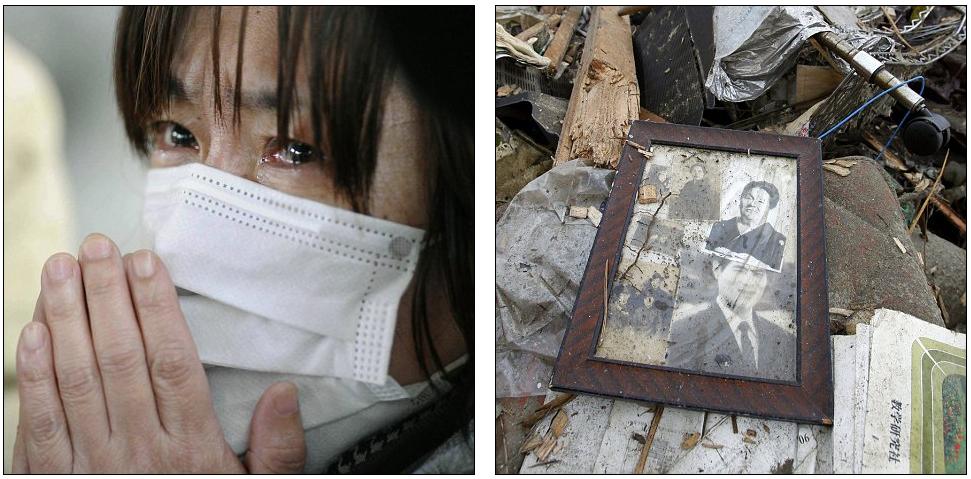
Tragic: A woman reacts to news that a loved one has died, left, and a picture of family members sits atop the rubble of a destroyed home, right


Officials of Tokyo Electric sat side by side in the capital and struggled to answer penetrating questions about the level of danger before government spokesman Yukio Edano admitted that dangerous levels of radioactive substances had been spilled into the atmosphere.

Although the government said the real danger zone was within 19 miles of the plant, the radiation announcement caused panic among those within a radius of 100 miles. This was followed by the warning that anyone inside the radius had to stay indoors.

Should they venture outside, they were ordered to shower and throw away their clothes when they returned.

That order meant some 140,000 were trapped indoors in and around Fukushima. But many were already asking how long they will have to stay there.


Sea change: Fukushima Dai-Ichi plant before the tsunami hit, left, and how it is now, right


‘I left my parents behind,’ said a man who was fleeing in his car with his wife. ‘They didn’t want to leave their home and now they can’t go whether they want to or not.

‘The government needs to tell us how long this is going to last.’

Authorities told residents not to use their own vehicles, said Koji Watanabe, a 60-year-old taxi driver.

But with military vehicles focused on children, the elderly and the disabled, he got fed up waiting and decided to leave in his car.

He and his wife, who has lung cancer, did not have enough fuel to travel far.
Many petrol stations are closed, and those that are open have long queues.


EXCLUSIVE!!!! Anxious Foreigners Flee Japan Nuclear Crisis 2011-03-15


source: dailymail

Japan's apocalypse now: Rescuers pick their way through a wasteland of bodies, wreckage and people washing in rivers

By Daily Mail Reporter


-70-year-old woman found alive in house that had been washed away by the tsunami
-Japan injects £60.8bn into money markets after Nikkei plunges by more than 10 per cent
-Bread, tinned goods and batteries growing scarce as Japanese panic buy amid nuclear crisis
-Fears for hundreds of Britons believed missing. FO expresses 'serious concern' for at least 50


Wiped out: Rescue workers are dwarfed by the scale of the rubble as they pick their way through the shattered city of Otsuchi


With millions of people without electricity, thousands missing and warnings of an imminent second earthquake, the task for Japanese authorities is too daunting to imagine.

Some 3,000 people have now been confirmed dead since last week’s earthquake and subsequent tsunami but officials believe the death toll could rise into the tens of thousands, with a further 2,000 bodies washing up on the shores of north-east Japan yesterday.

Bodies wrapped in blue tarpaulins were laid on military stretchers and lined up for collection while panic-buying has begun in Japan amid fears of a second quake and growing concern about nuclear leaks.

And tonight there were fresh fears over the possibility of a full-scale nuclear disaster as the operator of stricken Fukushima Dai-Ichi nuclear power plant said a fire has broken out again at its No. 4 reactor unit.

United in death: The bodies of victims at a village destroyed by the tsunami in Rikuzentakata (left) and the wreckage of Toyota Yaris at the port of Sendai

Firefighting: Ships try to extinguish a blaze at oil refinery tanks in Ichihara, Chiba Prefecture, which has been burning since Friday's earthquake and tsunami

Rescue: Japanese relief workers carry a man who survived being buried alive for five days in Ishimaki (left) and a truck dangles from a collapsed bridge in Ishinomaki, northern Japan

Precarious: A house perches on top of a bridge in Ishinomaki after being swept away by the tsunami


Tokyo Electric Power Co. spokesman Hajimi Motujuku says the blaze erupted early Wednesday in the outer housing of the reactor's containment vessel.

The bad news came as survivors continue to struggle to find food and water as supplies run low. There have been major power outages since the double disaster, many planned to preserve resources.

As the stock market plunges and the government warns it is receiving just a fraction of the emergency aid it needs, it is unclear how Japan can even begin to tackle the destruction.

The level of desolation is on an epic-scale with many towns completely destroyed. A shattered infrastructure makes it almost impossible to move heavy lifting equipment and rescue crews have struggled to reach the worst hit areas.

The death toll from last week's earthquake and tsunami jumped today as police confirmed the number killed had topped 3,300, although that grim news was overshadowed by a deepening nuclear crisis. Officials have said previously that at least 10,000 people may have died in Miyagi province alone.

The International Atomic Energy Agency has confirmed that radiation had been released into the atmosphere after yet another explosion at the Fukushima Daiichi power plant, inside Number 2 reactor.

Eerie: Cars drive along one of the few passable roads in the devastated Minamisanriku where 10,000 people are feared dead

People carry the body of a victim through debris in Kesennuma, Miyagi, northern Japan

Squatting amid the ruins: A woman cooks for her family in front of their devastated house in Ishinomaki in Miyagi Prefecture (left) while an older survivor swaddles herself in blankets and gloves at makeshift shelter at Ofunato, Iwate Prefecture


Explosions had already occurred in the Number 1 and Number 3 reactors. Number 4 reactor is also on fire and there are fears for those who have not yet made it outside the 12-mile exclusion zone.

Rescuers have pulled a 70-year-old woman from her the wreckage of her home , four days after it was demolished in the Japanese quake.

The rescue of the elderly Sai Abe and a younger man pulled from rubble elsewhere in the region were rare good news following Friday's disaster.

Mrs Abe's son said he had tried to save his mother but could not get her to flee her home in the port town of Otsuchi. His relief at her rescue, he said, was tempered by the fact that his father is still missing.

'I couldn't lift her up, and she couldn't escape because her legs are bad,' Hiromi Abe said. 'My feelings are complicated, because I haven't found my father.'

Ship out of water: A boat dumped in the street in Hishonomaki, Miyagi, after being swept inshore by the tsunami

Heart of the wasteland: Japanese survivors of Friday's earthquake and tsunami walk under umbrellas through the leveled city of Minamisanriku

Swept away: A house drifts in the middle of the Pacific Ocean after being hit by the tsunami (left) while people are forced to wash their clothes by a river at Otsuchi, northeastern Japan

Vanished: An astounding aerial view of the tsunami-devastated town of Rikuzentakata shows the full scale of the damage. Very little remains

Match stick city: Heavy machines crawl through the rubble in Rikuzentakata (left) while a rescue crew surveys the damage in Ofunato, northeastern Japan

Mrs Abe was suffering from hypothermia and sent to a hospital, but appeared to have no life-threatening injuries.

Another survivor, described as being in his 20s, was pulled from a building further down the coast in the city of Ishimaki after rescue workers heard him calling for help.

Conditions for those still alive in the rubble worsened as a cold front arrived today, further pushing down temperatures. Snow is forecast over the next few days
Millions of people spent a fourth night with little food, water or heating in near-freezing temperatures as they dealt with the loss of homes and loved ones. Asia's richest country has not seen such hardship since the Second World War.

Hajime Sato, a government official in Iwate prefecture, one of the hardest-hit, said deliveries of supplies were only 10 per cent of what is needed. Body bags and coffins were running so short that the government may turn to foreign funeral homes for help, he said.

Indonesian geologist Hery Harjono, who dealt with the 2004 Asian tsunami, said it would be ‘a miracle really if it turns out to be less than 10,000’ dead.

The 2004 tsunami killed 230,000 people - but only 184,000 bodies were found.

The impact of the earthquake and tsunami dragged down stock markets. The benchmark Nikkei 225 stock average plunged for a second day today, nosediving more than 10 per cent to close at 8,605.15 while the broader Topix lost more than 8 per cent.

To reduce the damage, Japan's central bank made two cash injections totalling 8 trillion yen (£60.8 billion) into the money markets today.

Initial estimates put repair costs in the tens of billions of dollars, costs that are likely to add to a massive public debt which , at 200 per cent of gross domestic product, is the biggest among industrialised nations.

The pulverised coast has been hit by hundreds of aftershocks since Friday, the latest a 6.2 magnitude quake which was followed by a fresh tsunami scare yesterday.

As sirens wailed, soldiers abandoned their search operations and told people on the devastated shoreline to run to higher ground.

The warning turned out to be a false alarm.

‘It’s a scene from hell, absolutely nightmarish,’ said Patrick Fuller, of the International Red Cross Federation.

‘The situation here is just beyond belief. Almost everything has been flattened.’

Pictures released by NASA shows the Japanese city of Ishinomaki (left) after the tsunami and in 2008 (right). Water is dark blue, plant-covered land is red, exposed earth is tan, and the city is silver.

Japan Red Cross president Tadateru Konoe added: ‘After my long career in the Red Cross where I have seen many disasters and catastrophes, this is the worst I have ever seen.’

The Japanese government and aid agencies are struggling to ferry food, water and medicines to survivors after panic-buying stripped shelves bare in the few shops left standing.

Far outside the disaster zone, stores are running out of necessities, raising government fears that hoarding may impede the delivery of emergency food aid to those who really need it.

‘The situation is hysterical,’ said Tomonao Matsuo, spokesman for instant noodle maker Nissin Foods, which donated a million items including its Cup Noodles for disaster relief. ‘People feel safer just by buying Cup Noodles.’

The company is trying to boost production, despite earthquake damage which closed down its facilities in Ibaraki prefecture until today.

The frenzied buying is compounding supply problems from damaged and congested roads, stalled factories, reduced train service and other disruptions caused by Friday's magnitude 9.0 earthquake off Japan's north-east coast and the major tsunami it generated.

Officials have been overwhelmed by the scale of the crisis, with millions of people spending a fourth night without electricity, water, food or heat in near-freezing temperatures.

A ship is seen perched on top of a house in the tsunami devastated remains of Otsuchi, Iwate prefecture

Details of the scale of the disaster (left) while destroyed houses are seen in the river at a devastated area hit by earthquake and tsunami in Kesennuma (right)

Ghost town: A once thriving industrial town off the coast in notheast Japan that has now been decimated by the tsunami wave that washed over the region


Officials estimate that 430,000 people are living in emergency shelters or with relatives.

The government has sent 120,000 blankets, 120,000 bottles of water and 29,000 gallons of petrol plus food to the affected areas.

The stock market plunged over the likelihood of huge losses by Japanese industries including big names such as Toyota and Honda following the 9.0 magnitude quake on Friday.

Almost 2million households are without power in the freezing north and about 1.4million have no running water while drivers are waiting in queues for five hours for rationed petrol.

Grim: The Japanese army search for bodies in Higashimatsushima City, in Miyagi, the state where up to 10,000 people may have died

Clean up: Police walk in file down a hillside today into a coastal town in northeast Japan that has been flattened by the tsunami wave


Experts are now warning a second huge quake - almost as powerful as the first - could hit the country, triggering another tsunami.

The director of the Australian Seismological Centre, Dr Kevin McCue, told the Sydney Morning Herald that there had been more than 100 smaller quakes since Friday, and a larger aftershock was likely.

'Normally they happen within days.

'The rule of thumb is that you would expect the main aftershock to be one magnitude smaller than the main shock, so you would be expecting a 7.9.

'That's a monster again in its own right that is capable of producing a tsunami and more damage.'

In a rare piece of good news, a 70-year-old woman has been found alive four days after the devastating earthquake and tsunami in north-eastern Japan.

Osaka fire department spokesman Yuko Kotani said the woman was found inside her house which had been washed away by the tsunami in Iwate prefecture.

Her rescuers, from Osaka in western Japan, had been sent to the area for disaster relief.

Ms Kotani said the woman was conscious but suffering from hypothermia and was being treated in hospital. She would not give the woman's name.


Source:dailymail

Twitter Delicious Facebook Digg Stumbleupon Favorites More

 
Top Web Hosting | manhattan lasik | websites for accountants